Availability
Availability is confirmed with the quotation.
Signal Amplifier
SAMP03 is a signal amplifier for tension sensors, converting low-level sensor signals into standard output signals for tension controllers, PLCs or monitoring systems.
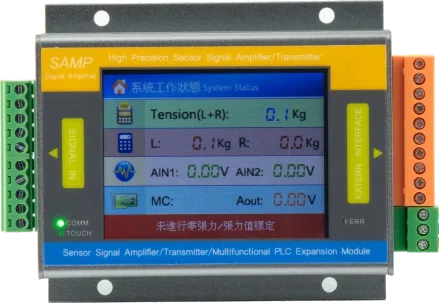
Key Features
| Model | SAMP03 |
|---|---|
| Product Type | Tension signal amplifier |
| Power Supply | DC 24 V, 55 mA |
| Main Channel Supply | DC 5 V, 200 mA max. |
| Main Channel Input Signal Level | Differential ±20 mV or ±200 mV, common mode −0.3 V to 4.0 V |
| Main Channel Temperature Drift | 0.5 ppm/°C |
| Main Channel Data Update Rate | Low speed 18 Hz, high speed 77 Hz |
| Digital Input | 1 NPN input |
| Auxiliary Analog Input | 2 channels 0–10 V |
| Auxiliary Analog Input Resolution | 12-bit ADC |
| Analog Output | 1 channel 0–10 V or 0–20 mA |
| Analog Output Resolution | 12-bit DAC |
| Communication Interface | RS-485, 8 data bits, 1 stop bit, no parity |
| Communication Protocol | Modbus RTU |
| Display | 2.8-inch 260K color TFT |
| HMI | Touch screen |
| Protection Rating | IP53 |
Replacement & Spare Part
Match the sensor input and the signal expected by the receiving PLC, computer or controller before ordering.
Availability is confirmed with the quotation.
Confirm the differential input range, ±20 mV or ±200 mV, and the DC 24 V supply. Send the amplifier label, wiring and mounting photos, plus the connected sensor model.
Check whether the machine uses 0–10 V, 0–20 mA or RS-485 Modbus RTU. Send the PLC or other receiving controller model and its input specification.
Check which output mode is set (0–10 V or 0–20 mA) and whether it matches the PLC input.
The amplifier has a low-speed (18 Hz) and a high-speed (77 Hz) update setting; check which is selected.
Check the 5 V sensor supply from the amplifier and the input range setting (±20 mV or ±200 mV) against the sensor’s output.
SAMP03 converts a tension sensor signal into standard outputs for a PLC, computer or another controller. The sensors listed in this range connect directly to TC100 without SAMP03; an amplifier is not required in that signal path.
Bridge-type tension sensors or LVDT micro-displacement sensors
0–10 V, 0–20 mA, RS-485 / Modbus RTU or controller input
Signal conditioning, tension feedback conversion and PLC / controller integration
The LC100A sensor’s 10 mV or 200 mV output falls within SAMP03’s two differential input ranges, ±20 mV and ±200 mV respectively. Check the selected input range against the sensor output.
Choose SAMP03 when tension sensor feedback needs to be converted into a standard output signal for a controller, PLC, computer or monitoring system.
| Good Fit | Tension sensor signal conditioning, PLC integration, remote monitoring and multi-device feedback applications. |
|---|---|
| Check First | Confirm sensor type, signal level, required output signal, communication protocol and installation environment before selection. |
| System Match | Use with compatible tension sensors and tension controllers according to the required signal output and control architecture. |
An alternative control path: the tension sensor connects directly to TC100, without SAMP03.
View ModelCompact pedestal-mount tension sensor with low temperature drift, high stability and good linearity.
View ModelStainless-steel through-shaft tension sensor with IP66 protection for harsh converting environments.
View ModelLive-shaft flange tension sensor with built-in self-aligning bearings for reliable web tension measurement.
View ModelCompact flange tension sensor with self-aligning bearings for easy roller installation and maintenance.
View ModelCantilever roller tension sensor for stable detection independent of web position on the roller.
View ModelConverts tension sensor feedback into standard signals for PLC or computer systems.
Provides conditioned feedback signals for automatic tension control systems.
Useful when adding tension feedback to existing converting or rewinding equipment.
Supports signal processing where stable sensor feedback is required.
New to tension control? See what web tension control is and how it works for how this component fits into the control loop.