Availability
Normally held in stock. Orders confirmed before midday China time usually ship within 2–3 working days. That is dispatch, not delivery — transit time depends on the courier and destination, and we quote it with the price.
Automatic Tension Controller
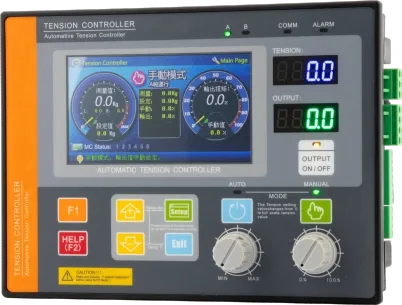
TC100 is an automatic tension controller for maintaining stable web tension in unwind, process and rewind sections. It supports constant tension, taper tension and speed-synchronous control for converting and web handling lines.
Key Features
| Model | TC100 |
|---|---|
| Product Type | Automatic tension controller |
| Display | 4.3-inch color screen with LED digital displays |
| Control Modes | Automatic constant tension, taper tension, semi-automatic control and speed-synchronous tension control |
| Manual Setting | Dual potentiometers for tension and manual output setting |
| Calibration | One-step zero adjustment and tension calibration |
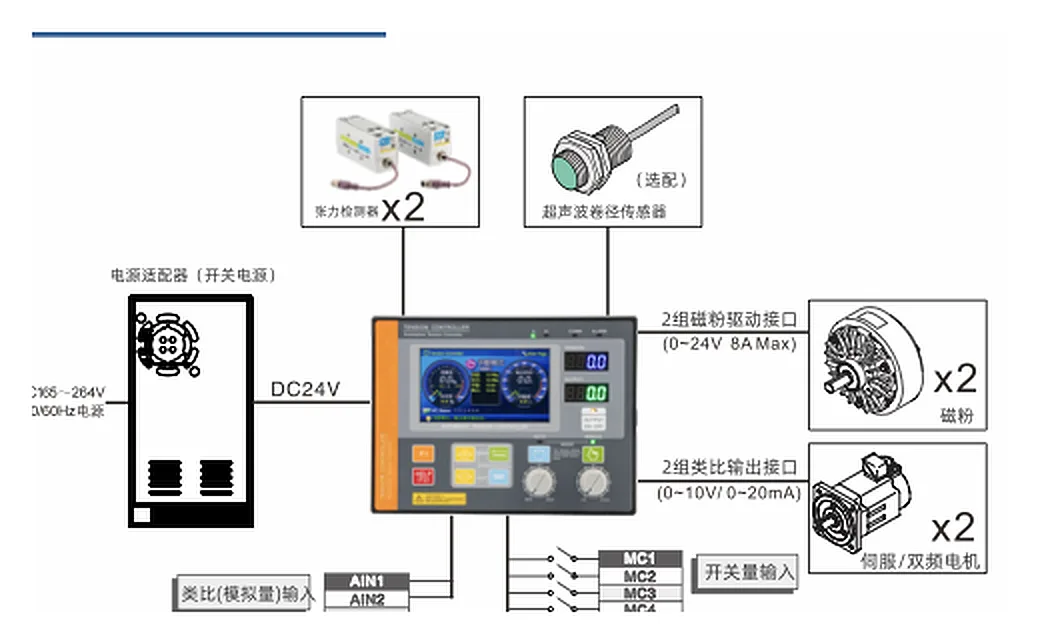
| Output / Drive Compatibility | Magnetic powder clutch/brake, pneumatic clutch/brake, torque motor, servo motor and dual-frequency motor |
| Axis Output | Dual-axis output for A/B axis switching |
| Installation | Embedded, wall-mounted or integrated installation |
Replacement & Spare Part
TC100 drives magnetic powder clutches and brakes, pneumatic clutches and brakes, torque motors, servo motors and dual-frequency motors. When replacing a tension controller, the output side is what decides whether a unit drops in — the controller has to match the actuator the machine already has.
Normally held in stock. Orders confirmed before midday China time usually ship within 2–3 working days. That is dispatch, not delivery — transit time depends on the courier and destination, and we quote it with the price.
A photo of the controller in the panel with its wiring, the make and model of the brake, clutch or motor it drives, and the load cell model if the line runs closed loop. Panel cut-out size matters if the housing has to fit an existing opening.
The controller. Load cells and signal amplifiers are separate items. Brakes, clutches and motor drives are not supplied — the controller is selected to work with the ones already on the machine.
Output and drive compatibility is the first thing to confirm, then the control modes the line needs and the panel installation type. Compare them against the table above.
Dimension drawing: available on request. Ask for it by email and check it against the unit on your machine before ordering.
Not every fault that looks like a failed unit is one. These are the patterns we are asked about most often, and what they usually turn out to mean.
Normal behaviour for an open loop or for a broken feedback path. Check that the load cell signal is reaching the controller before assuming the controller has failed. See how tension control works.
Can be the output stage, but a seized brake or a disconnected drive command looks the same from the panel.
Often the load cell or the signal amplifier rather than the controller. Recalibrating against a known weight will separate the two.
Check the taper setting and the diameter signal source. Roll defects can also come from nip pressure and winding geometry rather than tension.
If the symptom is not on this list, describe it in your message. It is cheaper for both of us to identify the actual fault than to ship the wrong part.
System Wiring Reference
Signal amplifier for tension sensors, converting sensor feedback into standard outputs for PLCs, computers or controllers.
View ModelCompact pedestal-mount tension sensor with low temperature drift, high stability and good linearity.
View ModelStainless-steel through-shaft tension sensor with IP66 protection for harsh converting environments.
View ModelLive-shaft flange tension sensor with built-in self-aligning bearings for reliable web tension measurement.
View ModelCompact flange tension sensor with self-aligning bearings for easy roller installation and maintenance.
View ModelCantilever roller tension sensor for stable detection independent of web position on the roller.
View ModelMaintains stable tension as roll diameter changes during unwinding.
Supports taper tension and consistent roll formation during rewinding.
Stable web tension for printing, coating, laminating and converting processes.
Tension control support for unwind, process and rewind sections.
New to tension control? See what web tension control is and how it works for how this component fits into the control loop.